

 en
en  English
 Español
 русский
 Deutsch
 عربى
عربىWhat Makes a Camping Table Factory a Reliable Partner for Outdoor Furniture Production and Supply Chain Needs
In outdoor furniture manufacturing, a Camping Table Factory is often judged by how it manages long term cooperation rather than only focusing on production output. Stability in cooperation usually comes from how each stage of work is handled, from early communication to final assembly.
In many cases, buyers pay attention to whether a factory can keep product consistency across repeated orders. This includes structure alignment, surface finishing, and how different components are combined during assembly.
Another practical factor is how information flows between both sides. When a factory is able to clarify design expectations early, the production process tends to move with fewer interruptions and adjustments.
Several elements usually shape this reliability:
- Coordination between material preparation and assembly work
- Clear confirmation of structure before production starts
- Handling of repeated orders with stable specifications
- Internal communication across different production steps
How It Production Capacity Influences Order Planning and Long Term Supply Stability
Production capacity in it is not only about how much can be made, but also about how smoothly different orders are arranged at the same time. In real production environments, multiple table designs often move through the system together, which requires careful scheduling.
When a factory organizes its workflow, it usually separates processes such as cutting, assembling, and final packing. This separation helps reduce confusion between different product styles and keeps work flowing more evenly.
Flexibility also plays a role. Some orders may require structural adjustments or surface changes, and a manufacturer often needs to adapt production sequences to match these requirements without slowing other work.
Key aspects that affect planning include:
- Balance between ongoing and new production tasks
- Adjustment between different product structures
- Storage and handling of semi-processed parts
- Coordination between planning and workshop teams
A Camping Table Factory with stable internal coordination can help reduce unexpected interruptions and support more predictable order handling over time.
What Materials Are Commonly Chosen and How They Affect Outdoor Performance
| Part of table | Material role | Main purpose |
|---|---|---|
| Frame | Structural support | Maintains balance and strength |
| Surface panel | Working area | Provides usable flat space |
| Folding joints | Movement control | Supports folding and opening behavior |
| External layer | Surface protection | Reduces impact from outdoor exposure |
How to Choose a Factory for OEM and Custom Camping Furniture Development Projects
When working on OEM or custom outdoor furniture projects, choosing a factory is often less about appearance and more about how the factory handles development details. Many projects start with a simple idea, but the process usually depends on how well the factory can translate that idea into a workable structure.
A practical point is how a factory responds to early design inputs. Some factories focus on standard models, while others are more flexible with adjustments in size, folding method, or surface layout. This difference often affects how smoothly a project moves forward.
Another point is communication during sampling. A manufacturer that can align drawings, prototypes, and feedback without repeated confusion usually helps reduce unnecessary back and forth.
Common considerations:
- Ability to adjust structure based on concept needs
- Clarity in sample making and revision steps
- Understanding of outdoor usage scenarios
- Willingness to support small scale trial production
In real development work, a Camping Table Factory that stays responsive during early stages often makes later production more stable and predictable.
Which Design Features Are Commonly Considered in Camping Table Factory Manufacturing for Modern Outdoor Use
In a factory, design decisions are usually shaped by practical outdoor use rather than visual complexity. The goal is to make tables that can handle different environments while staying easy to use.
One common focus is folding behavior. A factory often studies how quickly a table can be opened or stored, and whether moving parts remain aligned after repeated use. Small structural changes in hinges or support points can influence this behavior.
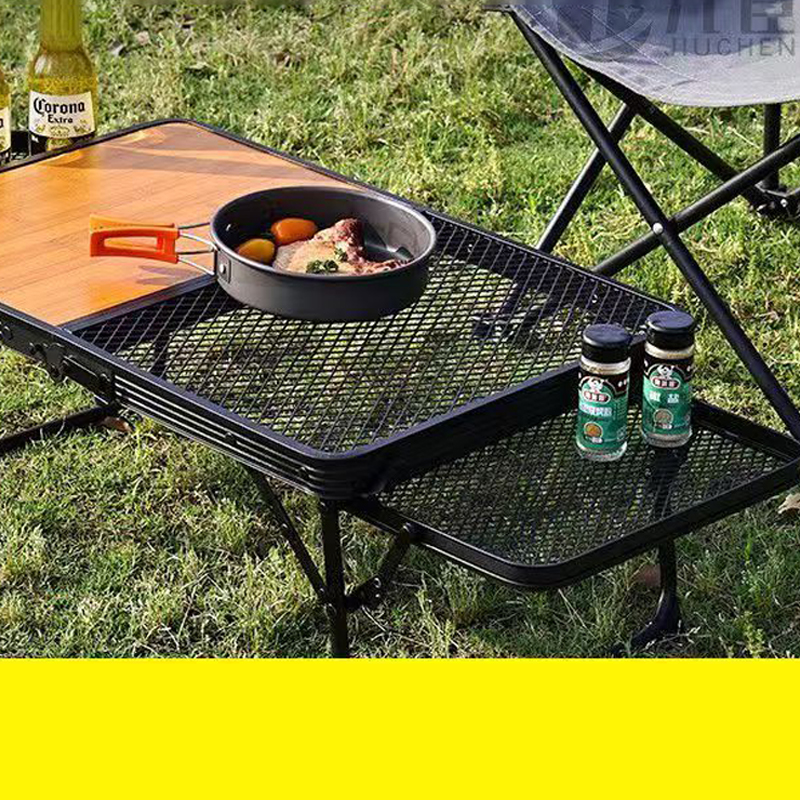
Surface usability is another consideration. Depending on usage, a factory may adjust texture or panel structure so the table can support cooking tools, food placement, or general camping needs without instability.
Key design aspects often include:
- Folding structure that reduces unnecessary movement
- Surface layout suitable for outdoor activities
- Frame balance to reduce uneven shaking
- Connection points that remain stable after repeated use
Why Lightweight Structure and Portability Matter in Camping Table Factory Product Development
In outdoor furniture production, a Camping Table Factory often pays close attention to weight balance and portability because these factors directly affect how the product is used in real situations.
A lighter structure makes transportation easier, especially when the table is carried with other camping equipment. However, reducing weight is not simply about removing material. A factory needs to keep enough structural support so the table does not lose stability during use.
Portability also depends on how the table folds and fits into storage space. A factory usually studies folding paths and component alignment to make sure the product can be stored without complex steps.
Important considerations include:
- Balance between weight and structural strength
- Folding size and storage convenience
- Ease of carrying in outdoor environments
- Stability after repeated setup and folding
What Quality Control Processes Are Used in a Camping Table Factory to Support Consistent Product Output
Inside a Camping Table Factory, quality control is usually not a single checkpoint but a continuous process that runs through different production stages. The goal is to keep each camping table aligned with the expected structure and usage behavior, especially when production involves repeated orders or multiple designs at the same time.
Early checks often focus on incoming materials. A factory typically reviews surface condition, thickness consistency, and basic structural suitability before parts enter production. This helps reduce later adjustments during assembly.
During assembly, attention shifts to fitting accuracy. A factory usually monitors whether frames align correctly, whether folding parts move smoothly, and whether joints stay stable after repeated operation.
Before packaging, final inspection often includes movement testing and surface review. This stage helps confirm that the product maintains consistent performance across batches.
Key checkpoints often include:
- Material condition before production starts
- Alignment during frame assembly
- Folding mechanism movement consistency
- Final structural stability check
How a Camping Table Factory Handles Custom Branding and Product Personalization for Outdoor Table Lines
Customization work in a Camping Table Factory usually begins with basic structural agreement, followed by visual and functional adjustments based on brand needs. Instead of changing the entire product, most customization focuses on controlled modifications within an existing structure.
Branding elements such as surface marking or logo placement are often integrated during the later stages of production. A Camping Table Factory typically ensures these details do not interfere with folding mechanisms or surface usability.
In many cases, personalization also includes adjustments in color tone, panel texture, or accessory compatibility. These changes are usually coordinated early so that production flow remains stable.
| Customization type | Typical adjustment | Purpose |
|---|---|---|
| Branding details | Logo or marking placement | Identity recognition |
| Surface finish | Color or texture variation | Visual alignment |
| Structural tweaks | Small frame adjustments | Usage adaptation |
| Packaging style | Box or protection method | Transport suitability |
How to Choose a Factory for OEM and Custom Camping Furniture Development Projects
When evaluating a manufacturer for OEM or custom projects, the focus usually shifts from product appearance to development capability. The way a factory handles communication, sampling, and adjustment often determines how smoothly a project progresses.
A practical starting point is how early design ideas are handled. A Camping Table Factory that can interpret sketches or functional descriptions into workable structures often reduces later revisions.
Sampling process is another key factor. Some factory operations provide quick adjustments during sample stages, while others require multiple rounds before reaching alignment. This difference can influence project timing and workflow stability.
Important evaluation points include:
- Responsiveness during early concept discussion
- Clarity in sample adjustment steps
- Ability to maintain structure consistency across revisions
- Support for small scale trial production
What Trends Are Shaping It Manufacturing and New Product Development in the Outdoor Market
In a factory, product development is gradually influenced by changing outdoor usage habits and evolving expectations around convenience and flexibility. Instead of focusing on one direction, manufacturers often adjust multiple aspects at the same time.
One noticeable direction is modular structure. The manufacturer may design tables that can be combined or adjusted for different use scenarios. This allows a single product line to serve multiple outdoor situations.
Another shift is related to storage efficiency. Folding methods are being refined so that tables take less space when packed, which is especially important for travel-oriented use.
Material combinations are also evolving. A factory may mix different structural materials to balance weight and durability without relying on a single material type.
Key development directions:
- Modular and adaptable structures
- More compact folding design approaches
- Mixed material usage for balanced performance
- Multi-scenario usability in one product line
