

 en
en  English
 Español
 русский
 Deutsch
 عربى
عربىWhat Makes a Camping Tent Factory a Reliable Source for Different Outdoor Camping Needs
A Camping Tent Factory is often evaluated based on how its production approach aligns with different outdoor usage requirements. Reliability is not defined by a single factor, but by how consistently it can respond to varied camping environments and user expectations.
In many cases, the same factory may serve multiple directions such as personal camping, group travel, or temporary outdoor setups. Each direction places different emphasis on structure, durability, and ease of use.
A key point is how production flexibility connects with real usage scenarios rather than fixed product definitions.
How a Camping Tent Factory Manages OEM Orders and Custom Design Requests for Global Buyers
When working with OEM or custom requests, the factory usually follows a structured but adjustable production path. The process starts from requirement communication and gradually moves toward sample confirmation and batch coordination.
What matters most is not only whether customization is possible, but how smoothly design adjustments can be translated into production reality.
| Stage | Focus Area | Key Consideration |
|---|---|---|
| Requirement alignment | Usage intent | Clear design direction |
| Sample creation | Structure and fabric | Functional feasibility |
| Adjustment phase | Feedback integration | Practical modification |
| Production phase | Consistency control | Stable output |
Which Camping Tent Designs from a Factory Work Well for Family Trips and Group Camping
Different camping scenarios naturally lead to different structural preferences. A Camping Tent Factory often develops multiple design categories to match these usage patterns.
Family-oriented use tends to focus on internal space arrangement and privacy zones, while group camping often requires shared areas and flexible internal layout.
Instead of a single design direction, several structural forms are commonly applied depending on usage behavior, such as compact dome shapes or extended tunnel layouts.
The choice is usually not about complexity, but about how well the structure supports real outdoor movement and shared living conditions.
How Camping Tent Factory Production Choices Affect Comfort and Outdoor Experience
Production decisions directly influence how a tent behaves in real outdoor environments. These decisions include fabric layering, frame design, and ventilation placement.
Comfort is usually connected to how well internal space interacts with external conditions such as airflow, temperature variation, and structural stability.
For example, tighter fabric structures may feel more stable in windy conditions, while lighter constructions may improve portability but change insulation behavior.
Rather than focusing on a single performance factor, production teams often balance multiple aspects to match intended usage scenarios.
Why Waterproof Fabric Selection Matters in Camping Tent Factory Manufacturing Process
Fabric selection plays an important role in how a tent performs under changing weather conditions. Within a Camping Tent Factory, this choice is usually considered at the early stage of product development.
Different fabric types respond differently to moisture exposure, long-term folding, and repeated outdoor use. This makes material planning a key part of structural reliability.
| Fabric Behavior | Practical Effect | Usage Context |
|---|---|---|
| Tighter weave structure | Stronger external resistance | Variable outdoor conditions |
| Lighter fabric composition | Easier transport and setup | Short-term use |
| Multi-layer construction | Balanced protection and comfort | Mixed environments |
Which Tent Features Are Commonly Requested by Buyers When Working With a Camping Tent Factory
In many cases, buyers approach a factory with clear expectations about how the tent should behave in real use rather than focusing only on appearance. Feature discussions usually start from practical needs in outdoor environments.
Some commonly mentioned directions include:
- Ventilation design for airflow in closed space
- Entry layout that supports easy movement
- Internal storage planning for small equipment
- Structure balance for uneven ground use
- Setup simplicity during short outdoor stays
How Design Adjustments Affect Tent Stability and Setup Time in Camping Tent Factory Production
Design changes are often introduced during development when structure needs refinement. In a factory, even small adjustments can influence both stability and how quickly the tent can be assembled.
Changes in pole positioning or connection points may shift how force is distributed across the structure. At the same time, simplifying assembly steps can reduce setup complexity, but it must be balanced against structural support.
The main challenge is keeping both stability and usability aligned, especially when design modifications are introduced late in the process.
How Camping Tent Factory Quality Control Steps Influence Product Stability and User Experience
Quality control is usually embedded throughout the production process rather than placed at a single final stage. This approach helps maintain consistency across different batches.
Checks are typically applied to material condition, stitching strength, and frame alignment during assembly stages. These points directly affect how the product performs once used outdoors.
Small variations in structure or fabric handling can influence long-term behavior, especially under repeated use conditions. Because of this, inspection is often repeated at multiple points instead of relying on a single evaluation stage.
Where Camping Tent Factory Products Are Commonly Used Beyond Traditional Outdoor Camping
Camping-related products are not limited to leisure environments or weekend outdoor trips. In many practical situations, the factory also produces structures that can be adapted to temporary, flexible, or short-duration use scenarios beyond standard camping activities.
These applications often appear when there is a need to quickly create a covered or enclosed space without permanent construction. In such cases, tents serve more as functional space solutions rather than purely recreational equipment.
Common usage directions may include temporary shelter setups in changing outdoor conditions, short-term activity spaces for gatherings or events, and outdoor coverage for organized group needs. In some situations, they are also used as transitional structures when fixed facilities are not available or not convenient to install.
The shared requirement across these different uses is usually related to speed of setup and adaptability. A structure that can be installed quickly and adjusted with minimal tools becomes more practical in environments where conditions may change or time is limited.
At the same time, a factory may make small structural adjustments based on different usage purposes. These adjustments do not necessarily change the overall design concept, but they help the product fit better into varied application contexts, whether for temporary coverage, storage space, or flexible outdoor arrangements.
When Buyers Should Work With a Camping Tent Factory for Custom Branding and Private Label Projects
Timing for customization usually depends on how stable the product direction is. Early-stage changes may still be frequent, which makes branding integration less consistent.
A more suitable stage is when structure, materials, and usage direction have already been generally defined. At this point, adjustments focus more on appearance and identification rather than core design.
This reduces repeated modification and helps keep production more aligned with final output expectations.
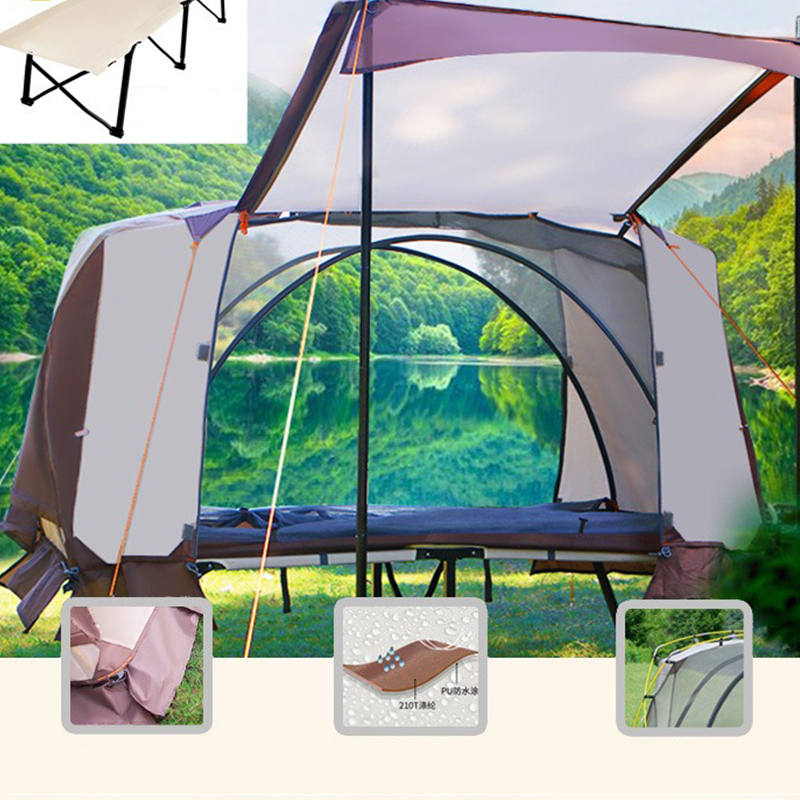
Tips for Choosing Camping Tent Materials Directly from a Factory for Different Weather Conditions
Material selection is closely connected to how a tent performs in real outdoor environments. When working directly with a factory, buyers usually focus on how different materials respond under changing weather rather than relying on a single fixed characteristic.
In practice, the decision often comes down to how the material behaves in everyday use conditions such as wind exposure, moisture contact, and temperature variation. These factors influence not only comfort but also how the structure holds up after repeated use and transport.
Two practical considerations are often used as a reference point:
- Response of the fabric to moisture and airflow in different environments
- Behavior of the material after folding, storage, and repeated setup cycles
Lighter materials are often selected when portability and quick handling are more important, while reinforced structures are usually preferred when stability under variable outdoor conditions is required. In some cases, a combination of materials is applied to balance these different needs within a single design.
Within production discussions, material planning is sometimes aligned with sourcing coordination handled by suppliers such as Zhejiang Mansen Leisure Products Co., Ltd., especially when buyers are comparing different fabric configurations for specific usage scenarios.
