

 en
en  English
 Español
 русский
 Deutsch
 عربى
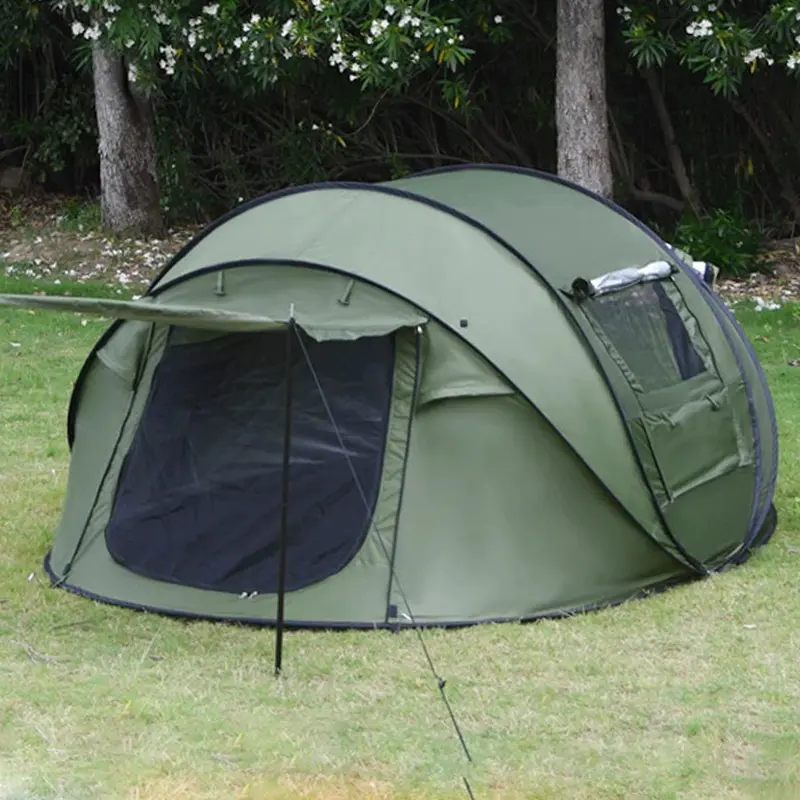
عربىArriving at a campsite after a long drive — tired, hungry, maybe with children asking when dinner is — the last thing anyone wants is to spend an hour wrestling with poles, guy lines, and instructions they cannot read in fading light. Traditional tent setup demands patience, practice, and ideally a second pair of hands. A Camping Tent Automatic Pop Up design cuts through all of that by collapsing the setup process into something close to instant: open the bag, release the tent, and it stands itself up. Understanding why that matters — and what it actually changes about the camping experience — is worth more than the feature list on any product page.
What Setup Time Actually Costs Campers
Time is the resource camping burns quietly. Getting to the site, parking, finding a flat spot, setting up camp — all of this happens before anyone rests, eats, or begins enjoying the reason they came. When setup runs long, it compresses everything else.
Consider the real impact:
- A late arrival means setup in the dark, adding difficulty and the risk of mistakes
- Children lose patience faster than tents go up — a long setup drains everyone's energy before the trip has started
- Sudden weather changes punish slow setup; a tent that takes thirty minutes becomes a problem when rain arrives after twenty
- Festival or group camping scenarios where multiple tents are needed make per-tent setup time multiply across the whole group
Setup time is not a trivial convenience feature. For families, casual campers, and anyone camping infrequently enough that they have not internalized the process, it directly affects whether the experience is enjoyable or frustrating.
How Does an Automatic Pop Up Tent Actually Work?
The mechanism behind a pop-up tent is a pre-tensioned flexible frame. Unlike traditional tents where poles must be assembled, threaded through sleeves, and bent into arcs under controlled tension, a pop-up tent stores that tension in the folded structure itself.
When the tent is released from its packed state:
- Flexible fiberglass or steel rods built into the tent fabric spring outward from their folded position
- The frame reaches its designed shape and locks into place through the natural resistance of the bent rods
- The tent fabric follows, pulled taut by the expanding frame
- The structure is stable and upright in seconds — no separate pole assembly required
Packing the tent reverses the process. The frame must be folded back into its flat circular configuration — a motion that takes practice but, once learned, requires only seconds.
The Automatic Instant Pop Up Tent format builds on this principle with refinements that make both deployment and packing faster, including frame joints that guide the folding motion and carry bags shaped to accept the flat-packed tent without a struggle.
Traditional Tent vs Pop-Up: Where the Time Goes
To understand the setup time saving, it helps to see exactly which steps the pop-up format eliminates.
| Setup Step | Traditional Tent | Pop-Up Tent |
|---|---|---|
| Stake out footprint | Required | Optional depending on conditions |
| Assemble poles | Yes — multiple sections | Not required |
| Thread poles through sleeves | Yes — time-consuming | Not required |
| Raise tent body | Yes — requires positioning | Automatic |
| Attach flysheet separately | Often required | Integrated in most designs |
| Tension and adjust | Yes — multiple guy lines | Reduced significantly |
| Stake corners | Required | Required |
| Total setup skill required | Moderate to high | Low |
The steps eliminated are not minor ones. Pole assembly and threading is where new campers lose the most time and make the most errors — particularly in low light or adverse weather. Removing those steps does not just save minutes; it removes the failure points that turn setup into an ordeal.
Where Pop-Up Tents Have the Clearest Advantage
Not every camping scenario benefits equally from the pop-up format. The advantage concentrates in specific situations.
Camping with Children
Kids do not sit still while tents go up. The faster the shelter appears, the sooner they are inside exploring it rather than running into roads or demanding attention at a moment when attention is already divided. A tent that stands itself up while a parent stakes the corners is a genuine practical advantage, not a luxury.
Arriving After Dark
Tent setup in daylight is one thing. Setup with a headlamp after a long drive is another. The fewer decisions and steps required, the lower the probability of a mistake that turns a manageable situation into a stressful one.
Short-Duration Camping
One-night stops, festival camping, and weekend trips where the tent goes up and comes down within twenty-four hours push the time-to-enjoyment ratio hard. If setup takes an hour and the stay is overnight, that is a significant proportion of the camping time spent on logistics rather than the activity.
Camping in Variable Weather
When weather is unstable, the time between "we should set up now" and "the rain has started" can be short. A pop-up design closes that window considerably. The faster a shelter can be established, the less exposure the camper and their gear face.
The Automatic Easy Outdoor Tent: What the Format Enables Beyond Speed
Speed is the headline, but pop-up tent designs often come with additional features that improve the overall camping experience.
Integrated Flysheet
Many Automatic Easy Outdoor Tent models integrate the rainfly into the same pop-out structure as the inner tent. In traditional designs, the flysheet is a separate component that must be fitted after the inner tent is up — adding steps and creating a period where the inner tent is exposed to rain if the weather turns during setup. Integrated designs eliminate that vulnerability.
Reduced Setup Errors
A tent that cannot be assembled wrong is genuinely useful for infrequent campers. The automatic frame means there is no "wrong way" to insert a pole, no sleeves to miss, no connections to misalign. The tent either pops open correctly or it does not — and if it does not, the problem is visible immediately rather than discovered after the tent collapses at midnight.
Lower Physical Demand
Traditional tent setup involves kneeling, threading, and sustained physical effort. A pop-up design reduces this significantly — relevant for users with mobility limitations, older campers, or anyone camping after physical activity who would rather rest than labor.
What Buyers Compare When Selecting a Pop-Up Camping Tent
Once the decision to use a pop-up design is made, the comparison between products moves to performance characteristics.
Weatherproofing
Speed means nothing if the tent leaks. Buyers evaluating pop-up designs look at:
- Seam sealing quality — taped seams versus stitched-only
- Flysheet coverage — how much of the inner tent is protected by the outer layer
- Ventilation design — a sealed tent that does not breathe creates condensation; good designs balance waterproofing with air circulation
- Ground sheet material and attachment — a tent that keeps rain out from above but lets it seep in from below has solved half the problem
Packaged Size and Weight
The compact storage advantage of a pop-up tent depends on how efficiently the flat-folded design packs. A tent that opens in seconds but requires a large dedicated bag is less useful for backpacking or transit-heavy travel. Buyers for retail or distribution programs look at packed dimensions relative to the tent's floor area.
Frame Durability
The pre-tensioned frame is the mechanical heart of a pop-up design, and it is also the component under the greatest cyclic stress. Each deployment and pack cycle flexes the frame materials. Quality here separates tents that hold up through a season of regular use from ones that develop frame failures after several outings.
- Fiberglass frames are lightweight and flexible but have a limited flex cycle life
- Steel frames are heavier but tolerate more cycles before fatigue becomes an issue
- The connection points between frame sections are typically where failure initiates — quality here matters more than the rod material alone
Capacity and Layout
A two-person pop-up tent set up in thirty seconds still needs to comfortably fit two people and their gear. Buyers evaluate:
- Stated versus usable floor area — a tent with a large footprint but steeply sloped walls has less usable interior than the floor dimensions suggest
- Door placement and count — single-door designs create traffic issues in family tents; two-door designs add convenience at modest weight cost
- Storage pockets and organization — small internal organization features matter more than they seem when gear is packed into a confined space
Sourcing Pop-Up Camping Tents for Retail or Branded Programs
For retail buyers, outdoor equipment distributors, and promotional merchandise programs, pop-up tent sourcing involves product performance alongside supply chain reliability.
Key considerations for volume sourcing:
- Consistent frame quality across production batches — frame failure rates should be confirmed through sample testing before volume commitment
- Certifications for target markets — some markets require fire-retardant material certifications for camping products; confirm applicability before ordering
- Custom branding options — fabric panel printing, carry bag branding, and label customization support branded product programs
- Pack configuration — retail display packaging differs from bulk export packaging; confirm format requirements before production
- Warranty and return support — pop-up tent mechanisms can fail if mishandled; clear warranty terms and replacement component availability affect retailer confidence
An outdoor product that performs in the field generates repeat purchase and positive reviews. One that fails its primary function — the fast, easy setup — generates returns and brand damage regardless of how competitive the price was at the time of ordering.
Sourcing from a Manufacturer with Outdoor Product Expertise
The pop-up tent mechanism looks simple from the outside. Getting it right — consistent frame behavior, durable materials, reliable weather protection, and packaging that survives retail handling — requires manufacturing experience and quality control that shows up in the product, not in the description.
Mansen Leisure Products designs and manufactures outdoor shelters including Camping Tent Automatic Pop Up formats for retail, promotional, and private label programs, with production capability covering a range of sizes, frame configurations, and customization options. If you are building a pop-up tent range for outdoor retail, a festival camping program, or a branded merchandise initiative, the product specification conversation is where the real work happens. Zhejiang Mansen Leisure Products Co., Ltd. works with buyers and product developers to match tent specifications to end-user requirements, and can provide samples, production documentation, and customization options before volume orders are confirmed.
