

 en
en  English
 Español
 русский
 Deutsch
 عربى
عربىOutdoor trips usually come with a small problem that turns into a big one once the bags start piling up. Water, chairs, boxes, coolers, and loose gear do not stay easy to carry for long. A folding wagon gives those items a place to sit and move together, which can make the walk from the car, campsite, or parking area feel less tiring.
What a Collapsible Camping Wagon Is and How It Supports Outdoor Carrying Needs
A Collapsible Camping Wagon is a foldable cart made for moving outdoor items without carrying each piece by hand. It usually has a folding frame, a fabric body, and wheels that let it roll across open ground.
People often use it for:
- Carrying camping gear between parking areas and campsites
- Moving picnic supplies across parks or open fields
- Hauling tools, bags, or small boxes outdoors
- Handling mixed items that are awkward to carry separately
The idea is simple. Instead of making several trips, the load comes along in one move. That is the part many people care about first.
Which Wheel Design Works Better for Grass Sand and Gravel Surfaces in a Collapsible Camping Wagon
Wheel shape changes the way the wagon feels the moment the surface changes. On firm paths, almost any wheel may seem fine. Once the ground gets softer or rougher, the difference becomes clear.
| Wheel Type Characteristic | Movement Behavior | Suitable Surface |
|---|---|---|
| Wider contact surface | Spreads pressure more evenly | Grass, sand |
| Narrow rigid wheel | Easier rolling on firm ground | Pavement, flat paths |
| Softer outer layer | Reduces vibration feel | Mixed terrain |
| Swivel front wheel | Improves direction change | Tight walking areas |
A wider wheel can help keep the cart from sinking too much in loose ground. Narrower wheels tend to roll more easily on hard surfaces. In practice, the wheel setup often decides whether a Collapsible Camping Wagon feels easy to guide or starts to drag.
Why Load Balance and Frame Design Matter in Outdoor Carts
A wagon can carry a lot of things, but how those things sit inside often changes the way it moves more than the total amount being carried. When heavier items end up on one side or are stacked unevenly, the cart can start to lean slightly, shift during turns, or require more effort to keep it moving in a straight line. Even small imbalances can be noticeable once the wagon is in motion.
This behavior is closely related to how the weight is distributed inside the structure, how stable the frame feels when it is fully opened, how the folding joints hold alignment, and whether the base stays level when pressure is applied. These elements work together rather than separately, and the overall feel depends on their combined stability.
When the load is uneven, the wagon may naturally drift toward one side or feel less predictable when changing direction. When the load is arranged more evenly, movement tends to feel smoother and easier to guide, especially on longer walks or slightly uneven ground.
With a Collapsible Camping Wagon, the frame is expected to maintain its shape each time it is opened and used again. If the structure shifts slightly after repeated folding, the wagon may feel less steady even before it is fully loaded, which can influence how controlled the movement feels during everyday use.
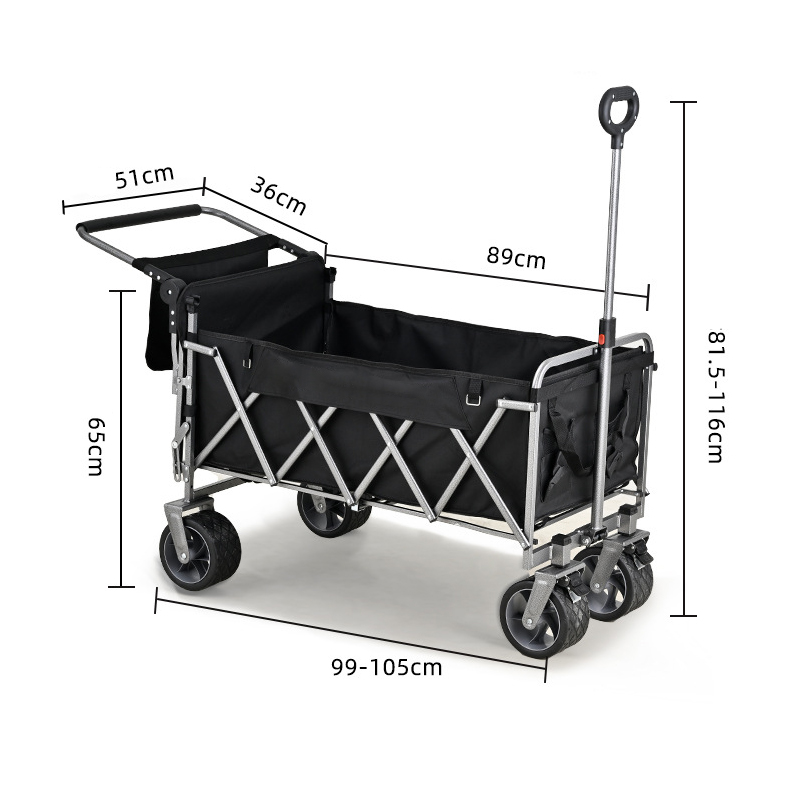
How Folding Structure Affects Storage Space and Car Trunk Fit for a Collapsible Camping Wagon
A folding wagon is often judged by how small it gets when stored away. That part matters more than many people expect, because a cart that folds poorly can still take up too much room at home or in a vehicle.
Common folding styles include:
- Side sections folding inward
- The base collapsing into a flatter shape
- The frame closing into a tighter bundle
- Wheels staying in place or lining up with the frame
A neater folded shape usually makes storage easier. It also helps when the wagon needs to go into a trunk, closet, or side space with limited room.
For a Collapsible Camping Wagon, folding design is not just about convenience. It affects whether the wagon feels practical on the way out and easy to put away afterward.
Where It Becomes Most Useful in Outdoor and Daily Life Scenarios
A folding wagon is often noticed in very ordinary situations rather than special ones. It tends to show its value when small or medium items start adding up and carrying them by hand becomes less convenient over short walks.
| Scenario Type | Typical Use Situation | Movement Character |
|---|---|---|
| Outdoor open spaces | Parks, campsites, picnic areas | Mixed surfaces, uneven paths |
| Coastal areas | Sand paths near shoreline | Softer ground, higher rolling resistance |
| Home related tasks | Yard work, storage transport | Short distance, repeated loading |
| Shared activity areas | Group setups, outdoor gatherings | Frequent stops, direction changes |
In these kinds of places, a Collapsible Camping Wagon is often used as a simple way to move several items together instead of making repeated trips. It is less about the weight of a single object and more about how many small things need to be moved at once.
How a Collapsible Camping Wagon Changes the Way You Pack for Camping Trips
Packing for outdoor trips usually starts with separate bags and loose items that do not naturally fit together. Once a wagon is used, the process often shifts into arranging everything as one combined load.
Instead of focusing only on packing each bag, attention moves toward how items sit inside the wagon. Heavier objects are usually placed closer to the bottom, while lighter ones go on top. Items that are needed earlier are often placed where they can be reached without unloading everything.
With a Collapsible Camping Wagon, packing starts to feel more like arranging a small movable storage space rather than carrying multiple separate loads. It reduces repeated lifting and keeps the movement between packing and departure more continuous.
Tips for Using It on Uneven Ground and Outdoor Paths
Outdoor paths rarely stay consistent, so the way the wagon is handled often matters as much as the design itself. Small adjustments in movement can make it feel easier to control.
- Start movement slowly instead of pulling with sudden force
- Keep the load as centered as possible to avoid side shifting
- Use wider turning space rather than sharp direction changes
- Maintain a steady walking rhythm instead of stopping and starting often
A Collapsible Camping Wagon usually responds more smoothly when movement is gradual and direction changes are not abrupt. This helps reduce small shifts in balance that can happen on uneven ground.
How Handle Design and Pulling Comfort Influence the Experience of a Collapsible Camping Wagon
The handle is the main contact point during use, and even small design differences can change how the wagon feels during movement. It affects posture, control, and how effort is distributed while walking.
- A longer handle gives more distance from the wagon body, which can make walking feel less restricted
- Adjustable height helps match different user heights and walking habits
- Grip material influences how stable the hold feels during longer movement
- Handle angle can affect wrist and arm comfort when the wagon is fully loaded
In a Collapsible Camping Wagon, these details become more noticeable during longer walking distances, when small differences in control and grip gradually affect overall comfort.
