

 en
en  English
 Español
 русский
 Deutsch
 عربى
عربىA camping table that sits at the wrong height creates friction across every activity it is supposed to support — cooking becomes uncomfortable, dining feels awkward, and the table that was meant to improve the campsite ends up being used as a bag shelf rather than an actual working surface. A Camping Table with Adjustable Height addresses this by letting the user set the surface level to match the task at hand, but choosing one well requires more than finding a product with telescoping legs. The adjustment mechanism, load capacity, material, and folded dimensions all interact in ways that matter significantly for how the table actually performs in the field.
Why Height Adjustment Matters More Than It First Appears
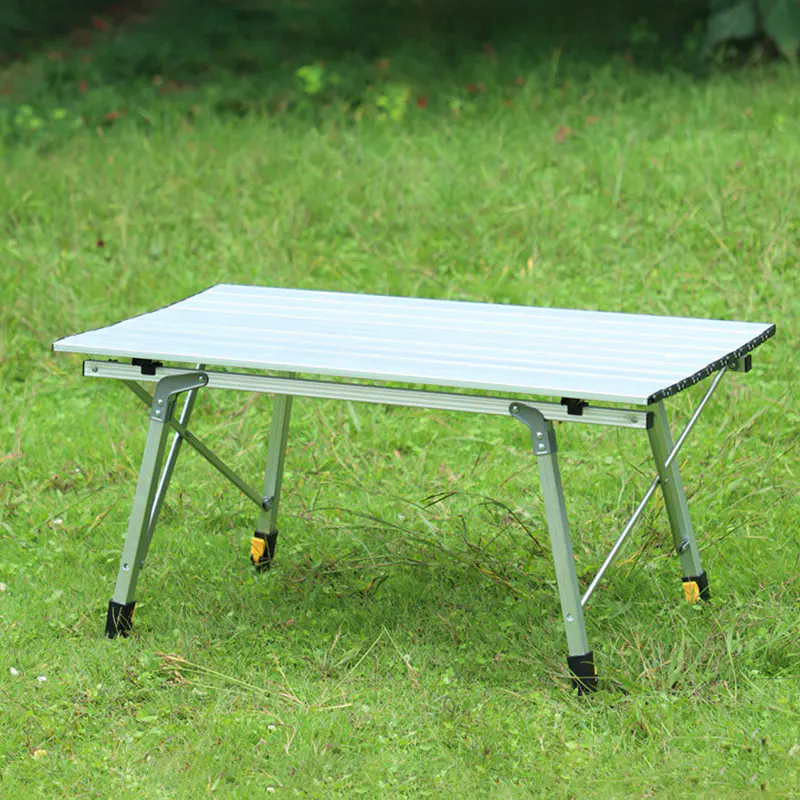
The Same Campsite Involves Multiple Different Working Heights
A fixed-height folding table is a compromise between dining height, food preparation height, and storage height — it rarely serves any of them particularly well. The height appropriate for sitting and eating a meal is lower than the height that works comfortably for standing and preparing food, and both differ from the height that makes sense when the table is being used as a gear surface at the edge of a tent.
Height-adjustable designs resolve this by treating the table as a tool rather than a fixture. At seated dining height, users can eat comfortably without hunching or stretching. Raised to counter height, the same surface allows standing preparation without back strain during longer cooking sessions. Lowered, it can serve as a low table for activities close to the ground, or for use with shorter seating.
This versatility is particularly relevant for family camping, where different users have different comfortable working heights, and where the table's function shifts across the day.
The Adjustment Mechanism: Where Most Buying Errors Happen
Not All Adjustable Leg Systems Work the Same Way
The mechanism that enables height adjustment is the most structurally significant aspect of any adjustable camping table, and it is the element that most directly determines the table's stability, durability, and ease of use. Different mechanisms make very different trade-offs between these factors.
Common adjustment mechanism types and their practical implications:
- Telescoping twist-lock legs: Each leg segment extends and locks at a set position through a friction or cam mechanism. These are lightweight and simple but can lose locking tension over time with heavy use, particularly in cheaper implementations.
- Pin-lock leg sections: A spring pin snaps into a hole in the leg tube at each height position, providing a more positive lock than friction systems. The height increment options are fixed by pin hole spacing rather than infinitely adjustable, which suits most users but limits fine-tuning.
- Flip-lock or lever-lock telescoping legs: A lever clamp locks the telescoping section at any height within the adjustment range. These provide the most flexible height setting but add mechanism complexity that creates more potential failure points.
- Removable leg extensions: Some folding outdoor camping tables use interchangeable leg inserts to achieve different height presets. This is mechanically simple and stable but less convenient than single-piece adjustable legs.
For buyers evaluating adjustable camping tables at wholesale volume, the mechanism type is worth understanding because it determines the failure modes the product will experience over time and affects the level of customer complaint and return likely to accompany a given design.
Stability Under Load at Different Height Settings
Does Adjustability Compromise a Table's Structural Integrity?
This is the question that most buyers who have used a wobbly adjustable table are asking, and it is the right question. An adjustable table that is stable when low but develops sway when extended to full height has a design limitation that affects its practical usefulness in the situations where the height adjustment matters.
Several design factors determine whether stability is maintained across the full adjustment range:
- Leg cross-section geometry: Round tube legs flex more under lateral load than rectangular or square section legs, particularly at extension — this is why some adjustable tables feel noticeably less rigid at full height than at compact setting
- Joint engagement depth: When a telescoping leg extends, the engaged overlap length between inner and outer tube sections decreases. Tables where this overlap becomes very short at full extension lose structural stiffness there regardless of how well the lock holds
- Brace and cross-support design: Tables with diagonal or cross bracing between legs maintain stability under side load better than those that rely on vertical leg geometry alone
- Tabletop panel attachment: A panel that flexes relative to the frame transfers dynamic loads to the leg structure, making a stiffer top panel an indirect stability factor
A practical test for buyers evaluating samples: extend the table to full height and apply a moderate lateral load to the tabletop surface. The table should resist that load without significant flex at the joints. Repeat with the table at its lowest and mid settings to assess whether stiffness changes significantly across the adjustment range.
Matching Table Type to Camping Context
Different Scenarios Call for Different Adjustable Table Designs
Height adjustability is not a single feature with the same value in every camping context. The type of outdoor activity, the number of users, the transport method, and the campsite surface all influence which adjustable table design actually serves the need.
- Solo travel and backpacking-adjacent camping: A travel camping table for solo use prioritizes packed weight and folded dimensions over surface area and load capacity. Adjustable designs in this category use aluminum frames and lightweight tabletop materials — sometimes roll-top slat constructions — to achieve packable dimensions that fixed-frame tables of similar area cannot match.
- Family camping and group setups: A family camping table needs surface area sufficient for multiple settings, load capacity adequate for serving dishes and shared items, and stability that holds through the kind of active use that includes children leaning on edges and items being placed and retrieved repeatedly. Adjustable designs in this category benefit from heavier-gauge frame construction and wider leg spacing that maintains stability at full height.
- Beach and outdoor event use: A waterproof camping table for beach or festival use encounters surface instability from sand and soft ground, as well as exposure to moisture and UV light. Adjustable legs with foot pads or tipped feet that spread load across soft surfaces help here. Material selection matters because salt air and direct sun exposure accelerate degradation of materials that perform adequately in forest or meadow camping.
- Camp kitchen and cooking setups: When the table's primary use is as a cooking surface, standing height adjustment becomes the priority. The ability to set the surface at a height that allows comfortable standing preparation without back strain is the defining value of adjustability in this context.
Material Selection for Adjustable Camping Tables
How Material Choice Affects Performance Across Height Settings
The tabletop surface material and the frame material both affect how an adjustable camping table performs in the conditions where it will be used.
| Material | Weather Resistance | Weight | Surface Feel | Durability | Maintenance |
|---|---|---|---|---|---|
| Aluminum Frame + Aluminum Top | Strong | Light | Hard, functional | High | Low — wipe clean |
| Aluminum Frame + Roll-Top Slat | Moderate | Lightest | Open, breathable | Moderate | Low — compact and easy to store |
| Steel Frame + Composite Top | Strong | Heavy | Functional | High | Low |
| Aluminum Frame + Wood Top | Moderate without treatment | Medium | Warm, natural | Medium with proper care | Medium — periodic sealing or oiling recommended |
| Steel Frame + MDF or Plywood Top | Low | Heaviest | Solid | Lower in humid or wet conditions | High — protect from moisture and standing water |
A wood top camping table carries aesthetic appeal that aluminum and composite surfaces cannot replicate. For buyers targeting markets where premium outdoor lifestyle products command higher prices, wood-topped adjustable tables offer a differentiation point. The management requirement is real, though — an untreated wood top exposed repeatedly to rain, dew, and humidity will warp, crack, or delaminate over time.
For buyers who prioritize low maintenance and high weather resistance, aluminum or composite tops are the practical specification. They clean easily, resist moisture without treatment, and hold up through seasons of active outdoor use without requiring owner intervention beyond basic cleaning.
Portability and Packed Dimensions
How Does Height Adjustment Affect How the Table Packs?
A common concern when evaluating adjustable tables is whether the added mechanism complexity increases the packed size relative to fixed-height alternatives. The answer depends on the design.
For tables where adjustment is achieved through telescoping leg sections rather than removable components, the folded dimension is often similar to a comparable fixed-height table because the telescoping mechanism is already integrated into the leg length. The folded height may be slightly greater than a simple fixed-leg design, but the difference is often modest.
For tables that add a separate height extension component, the packed form is slightly more complex — there is the table itself plus the extension hardware, which requires either attached storage or a separate carrying bag compartment.
A portable outdoor folding table with integral height adjustment that folds to a flat or near-flat form and fits into a carrying bag is the format that minimizes transport friction. Tables where adjustment requires managing separate components add operational overhead that some buyers and end users find discourages use of the height feature entirely.
What Wholesale Buyers Should Evaluate
A Sourcing Checklist for Adjustable Camping Table Procurement
For wholesale and retail buyers sourcing adjustable camping tables, the evaluation extends beyond individual product specifications to cover the supply chain relationship and the product's fit across the intended market segment.
Product-level evaluation:
- Test the adjustment mechanism across its full range before committing to a volume order — confirm the locking holds under real load at each height setting
- Evaluate stability at full extension under lateral and vertical load, not just vertical load alone
- Confirm folded dimensions and weight against the target end user's transport expectations
- Check the carrying bag quality — this affects customer experience significantly and is often the element that gets the most negative comment in retail reviews if it is inadequate
- Request samples in the range of materials the target market will require — different market segments have different material preferences that affect retail performance
Supplier evaluation:
- Confirm the supplier's experience with adjustable mechanism production and quality control at volume
- Understand the supplier's lead time and minimum order quantity for adjustable models, which often have higher production complexity than fixed-height alternatives
- Ask whether OEM customization is available for mechanism type, material combination, or dimensional specifications
- Verify whether the supplier can provide samples from actual production runs rather than only pre-production prototypes
Common Specification Mistakes When Buying Adjustable Tables
Errors That Show Up Only After the Order Arrives
Several specification errors in adjustable camping table procurement are visible only after a volume order has been received and the product is in use.
- Selecting adjustment range based on extended height without checking minimum height: A table that adjusts to a comfortable standing height may be too tall at its lowest setting for comfortable seated dining — the full range matters, not just the upper limit
- Assuming all adjustment mechanisms are equivalent: Friction-lock and pin-lock systems have very different durability profiles in high-cycle use — specifying by mechanism type rather than by feature name produces more reliable sourcing outcomes
- Ignoring the foot design on soft-ground applications: A table with narrow pointed feet may sink into sand or soft soil at standing height, creating instability that a wider foot pad design would prevent
- Not evaluating the tabletop attachment at full extension: At full extension, the joint between the tabletop panel and the frame experiences more flex than at lower settings — checking this junction under load at full height catches a category of failure that static evaluation misses
An adjustable height camping table solves real problems that fixed-height alternatives cannot, but the value of that adjustability depends entirely on whether the adjustment mechanism is reliable, the stability holds across the height range, and the table's other specifications — material, packed form, weight — suit the intended use context. For buyers building a product range in the outdoor furniture category, understanding how these factors interact helps identify which adjustable table designs will perform well for the intended end users and which will generate support issues and returns after the purchase. Zhejiang Mansen Leisure Products Co., Ltd. manufactures a range of camping tables including height-adjustable designs in aluminum and wood-top configurations, portable folding formats, and waterproof constructions suited to different market requirements. For wholesale buyers or brand developers evaluating adjustable camping table options, OEM specifications, or sourcing terms, reaching out to their team with application requirements and order parameters is a practical starting point.
