

 en
en  English
 Español
 русский
 Deutsch
 عربى
عربىYou get to the campsite later than planned, the light is fading, and the last thing you want is a forty-minute wrestling match with tent poles and rain-damp instruction sheets. Or maybe you are heading out for a long weekend with the family, and you need a space that actually feels livable — not just functional. These two scenarios pull in opposite directions, which is exactly why so many campers end up searching for a clear comparison between inflatable tents and the Automatic Instant Pop Up Tent before making a purchase. Both solve the problem of complicated setup, but they do it differently, and those differences matter a great deal depending on how and where you actually camp.
Neither option is a universal solution. An inflatable tent excels in specific situations — extended stays, family glamping, weather exposure — while an Automatic Easy Outdoor Tent wins in others: quick trips, solo or small-group camping, or any situation where speed and light packing matter. Working out which fits your camping pattern requires looking at the real performance differences between them, not just the marketing language that surrounds each category.
Setup Speed Is Not the Only Difference Worth Understanding
How Each Tent Type Actually Opens
An inflatable tent uses pressurized air in sealed tubes or beams to replace traditional pole structures. You attach a pump, inflate the frame, and the tent takes shape. The process is relatively straightforward compared to threading multiple poles through sleeves, but it still takes time — and it requires either a manual pump or a powered one, which adds a component to your kit.
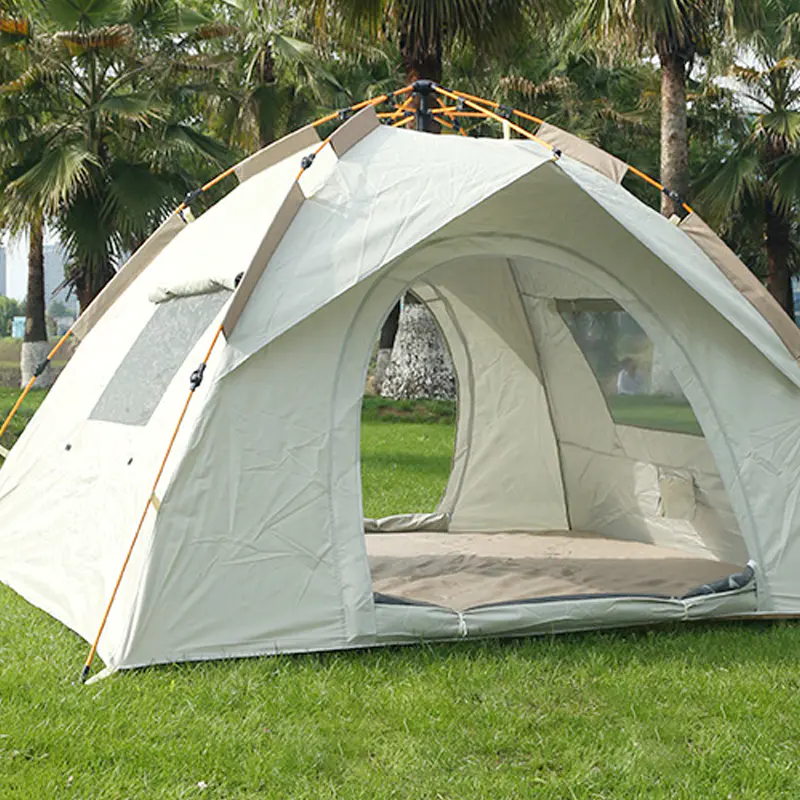
An Automatic Instant Pop Up Tent works on a different principle entirely. A spring-loaded frame is held compressed by a carry bag or retention mechanism. Release it and the structure expands on its own, usually within a few seconds. No pump. No assembly steps. No reading a diagram by flashlight.
This difference in deployment method has ripple effects beyond just setup time:
- Inflatable tents require access to a pump, which adds weight and can fail.
- Pop-up tents require no tools or accessories at all.
- Inflatable frames need to be deflated and carefully folded before packing.
- Folding a spring-frame tent correctly takes some practice but becomes quick with repetition.
For campers who value eliminating friction from arrival and departure, the Camping Tent Automatic Pop Up category wins on pure setup logic. But that advantage has context — it does not tell the whole story.
Interior Space and Comfort Are Not Equal
Does an Inflatable Tent Actually Feel Different Inside?
Yes, noticeably. Inflatable tents generally use their air beam structure to create a clean, pole-free interior. Without the intrusion of traditional poles or the compact spring frames of pop-up designs, the usable floor space and headroom in inflatable models tends to be more generous. For families spending multiple nights in one place, that spatial difference is meaningful.
The interior of a Camping Tent Automatic Pop Up model, by contrast, is shaped by its spring frame geometry. That frame is engineered for fast deployment, not architectural generosity. The result is a practical sleeping space — often very well-suited for two people — but not a living space in the way a larger inflatable tent can be.
This is not a flaw. It is a design priority. An Automatic Easy Outdoor Tent is built around the assumption that the occupant wants to be outside during the day and comfortable at night. An inflatable tent is built around the assumption that the tent itself is part of the experience — somewhere to eat, relax, and shelter when the weather turns.
Campers who primarily use a tent for sleeping and spend their days outside will barely notice the interior difference. Those setting up a camp as a base for days of activity will find the extra space in an inflatable tent worth the setup overhead.
Portability and Pack Size Change Everything for Certain Campers
How Much Does Weight Actually Matter When Choosing?
It depends entirely on how you get to your campsite. For car camping — where the vehicle parks close to the pitch and you carry gear a short distance — the weight of an inflatable tent is manageable. A compact vehicle can carry it without difficulty, and the extra space once set up justifies the load.
For campers who hike to their sites, carry their own packs, or use public transport to reach camping grounds, an inflatable tent's weight becomes a real constraint. Many family-sized inflatable models are heavy enough that carrying them any significant distance is impractical without a dedicated trolley or extra hands.
The Automatic Instant Pop Up Tent sits at a different point on the weight scale. Most are designed to be genuinely portable — carried in a round bag over one shoulder, packed into the overhead compartment of a vehicle, or slipped into the back of a motorbike. This portability is not incidental; it is central to why people choose this format.
A few practical considerations on portability:
- Inflatable tents pack into large bags that are hard to carry without a vehicle.
- Pop-up tents pack flat into a circular case — unconventional but manageable.
- Folding a pop-up tent correctly is a skill worth practicing before the first trip.
- Inflatable tents need their pump stored alongside them for every trip.
Weather Resistance: Where Inflatable Tents Have a Clear Structural Advantage
Can an Automatic Pop Up Tent Handle Bad Weather?
This is the area where the comparison becomes least ambiguous. Inflatable tents, when properly designed, handle wind and rain very well. The air beam structure has some inherent flex — it yields slightly under pressure rather than snapping — and the continuous frame creates a stable skeleton across the entire tent surface. High-quality inflatable models can manage exposed conditions that would challenge many traditional tents.
Automatic Instant Pop Up Tents vary considerably in weather performance, and it is worth being honest about that range. Entry-level pop-up designs, optimized for price and portability, typically offer moderate weather resistance — fine for calm summer nights, less reliable in wind or prolonged rain. Better-quality automatic tents use improved fabrics, reinforced frames, and higher-rated waterproofing to close some of this gap.
The structural reality is that a spring frame optimized for fast deployment is a different engineering compromise than a frame optimized for structural rigidity under load. For fair-weather camping and short trips where bad weather is unlikely, this is not a problem. For camping in coastal areas, high elevation, or regions with unpredictable weather, it becomes a relevant factor.
Campers who regularly deal with difficult weather and still want quick setup have two practical options: invest in a higher-specification automatic tent, or accept that an inflatable tent's setup time is worth the stability it provides.
Comparing the Two Formats Across Key Decision Factors
A side-by-side view helps clarify where each type performs well and where it has limitations.
| Feature | Inflatable Tent | Automatic Instant Pop Up Tent |
|---|---|---|
| Setup time | Moderate — requires pump and inflation | Very fast — seconds to deploy |
| Pack size | Large — requires significant storage space | Compact — circular flat bag |
| Weight | Heavier | Lighter |
| Interior space | Generous — pole-free living area | Functional — optimized for sleeping |
| Weather resistance | Strong structural performance | Moderate; varies by product quality |
| Family suitability | Well-suited for extended family trips | Better for smaller groups or solo |
| Portability on foot | Difficult for longer carries | Manageable |
| Setup skill required | Low to moderate | Low; packing takes practice |
| Pump dependency | Yes | No |
| Durability | High when maintained | High at quality tier; variable at entry level |
Reading across that comparison, neither option dominates across all factors. The inflatable tent trades portability and setup speed for space and structural stability. The Automatic Easy Outdoor Tent trades interior volume and weather performance for speed, lightness, and flexibility.
Who Actually Benefits From Each Option?
Inflatable Tents Work Well When...
The case for an inflatable tent strengthens under specific conditions:
- You are camping with a family that needs genuine living space, not just sleeping space.
- You use a vehicle to transport gear and can accommodate the bulk.
- Your camping trips extend over multiple nights where the tent serves as a base.
- You camp in exposed or unpredictable weather and need structural reliability.
- Comfort and the camping experience itself are priorities alongside the outdoor activities.
- You are setting up a glamping-style camp where the tent's interior matters aesthetically and practically.
The Automatic Tent Suits a Different Kind of Camper
The Camping Tent Automatic Pop Up format makes strong sense for:
- Solo campers or couples who want to pack light and move freely.
- Weekend campers who arrive after work on a Friday and break down Sunday morning.
- Campers who prioritize being outside and see the tent primarily as a place to sleep.
- Festival attendees or event campers where speed of setup and takedown is important.
- New campers who want to reduce the learning curve of tent setup without sacrificing function.
- Anyone camping in fair-weather conditions where weather resistance is a secondary concern.
These are not rigid rules. Plenty of families use automatic pop-up tents happily, and plenty of solo campers choose inflatable models for the comfort. But understanding the design priorities behind each format helps clarify which will perform better in your actual use case.
Does the Long-Term Value Calculation Favor One Option?
How to Think About Cost Across Multiple Trips
Upfront price is one part of the calculation. Durability, maintenance, and long-term usability are the rest. Inflatable tents at quality levels require care — the air beams need to be checked for slow leaks, the fabric needs to be stored dry to prevent mold, and any damage to the beam system can make field repair challenging.
Automatic pop-up tents have their own maintenance considerations. The spring frame, if bent or damaged, is difficult to repair in the field. The folding mechanism can lose its spring tension over years of use. Fabric quality at the entry-level price point may degrade faster than premium alternatives.
For campers who go out many times per year, investing in a higher-quality version of either type pays off in consistent performance. For occasional campers — a few trips per year — a well-designed automatic tent at a mid-range price point often delivers good value without the overhead of maintaining a larger, more complex inflatable model.
Matching the Tent to the Trip, Not the Other Way Around
Some campers try to find one tent that works for every scenario. It is a reasonable goal, but the inflatable versus pop-up comparison illustrates why a single product rarely covers all bases. The design priorities of each format pull in different directions, and what makes an inflatable tent strong in one context is exactly what makes it less practical in another.
A more useful framing: think about the trip you take most often, not the trip you might take occasionally. If most of your camping is quick, light, and weather-benign, an Automatic Instant Pop Up Tent serves that pattern well. If most of your time outdoors involves longer stays, family groups, or unpredictable conditions, an inflatable tent earns its setup overhead.
Choosing between an inflatable tent and an Automatic Instant Pop Up Tent is genuinely a question of camping style rather than product quality. Both categories include poorly made options and well-engineered ones — the design format is not itself a quality indicator. What changes is the use case each format is built around, and aligning that with your actual camping pattern is what produces a satisfying purchase. If you camp frequently with a family in varied conditions, an inflatable tent's stability and space are hard to match. If you value quick setup, lighter packing, and the freedom to move with minimal gear, a well-made Automatic Easy Outdoor Tent fits that pattern with less friction than almost any other shelter format. Zhejiang Mansen Leisure Products Co., Ltd. produces a range of automatic pop-up tents designed for fast deployment, genuine portability, and reliable performance across a variety of camping contexts — reach out to discuss product specifications or sourcing requirements for your market.
